APPRECIATION OR APPROPRIATION?
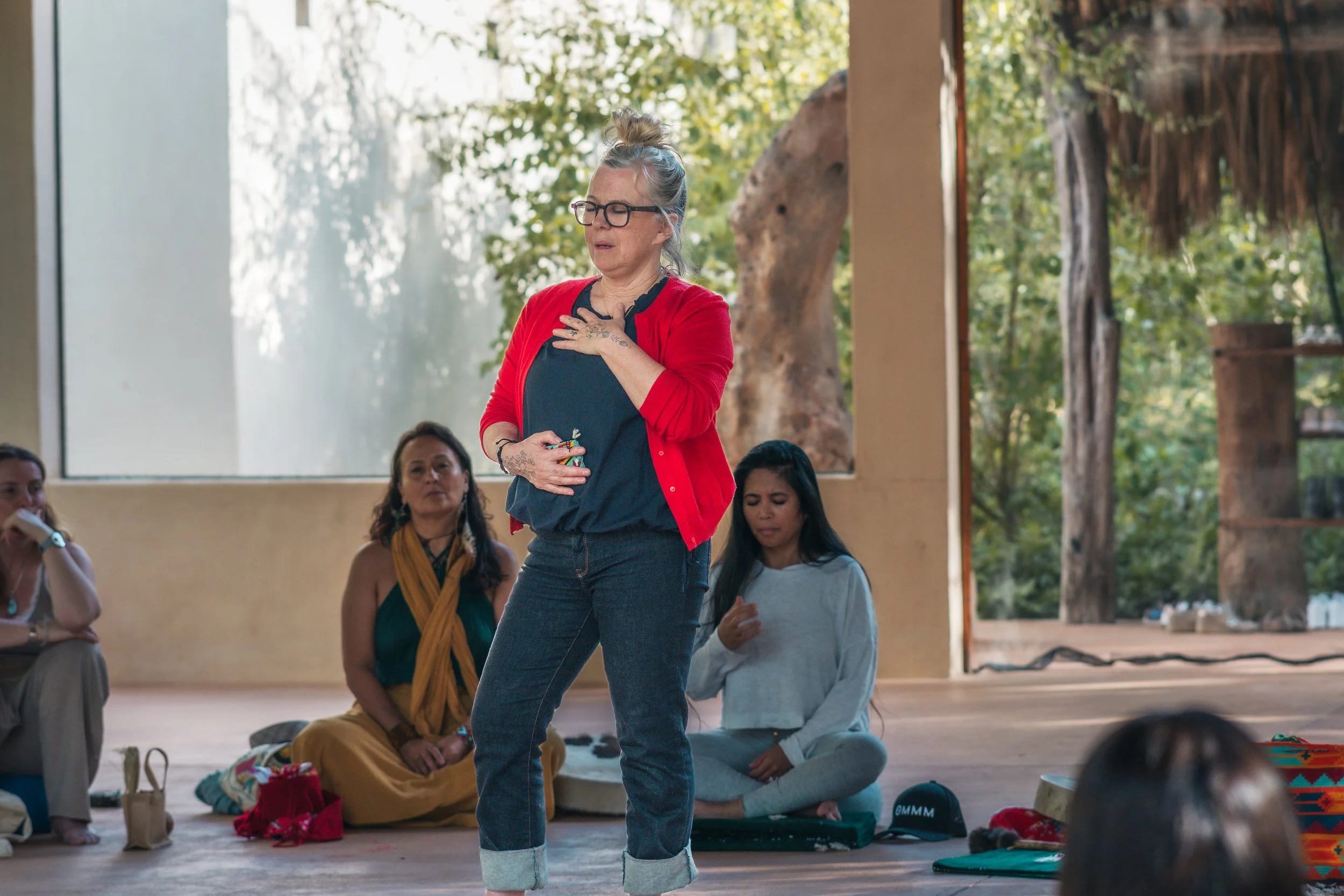
photo credit Bruno Calvis - Mexico 2026
At our most recent student graduation, my colleague and lead trainer of our North America Training, Rebecca Llewellyn, delivered an hour-long talk on sacred allyship, and the fundamental difference between appreciation, and appropriation.
We started with a significant question:
“Who was once punished for this practice, and who now profits from it?”
Once you start digging into this inquiry, you can’t un-see what you have seen, or become less aware than you were before. It’s our responsibility if working with sacred practices, tools, items and ‘medicines’ to deeply attune to where these things came from and who paid the cost of our often unacknowledged use and privilege.
What we teach inside Seven Directions
Throughout our training, we are explicit: if a student doesn’t have shamanic training or apprenticeship within a particular lineage, we strongly advise against using items or practices borrowed from other cultures. Being innocent is one thing but being ignorant another thing altogether, so we make it very clear that our breathwork program is not a shamanic training and we’re teaching the essence of breathwork practice rather than teaching about ceremony, ritual or shamanism.
In the wider spiritual wellbeing world, it’s very easy to dip into these borrowed cultures, something we see constantly on social media. We’re not here to judge - everyone is on their own journey toward better practice, so really we’re here to share our perspective from within Seven Directions Breathwork and to hold the same mirror up to ourselves whist we do it.
It’s important to say that there is no single perspective on this. Indigenous peoples don’t all agree on what can and can’t or should and should not be shared. Indeed there is significant lateral violence inside communities, between tribes, and between practitioners. One thing that is broadly agreed upon though, is the harm caused by colonisation and the appropriation of essential ways of life that have been taken, monetised, and repackaged by people of other roots and ancestry who get rich on the profits of those practices whilst those they originate from remain in struggle.
It’s perhaps tempting to take it back to the beginning and say ‘we are all one people’, and in a sense, yes this is true, but to say it without careful analysis is to bypass the harm of millennia of capitalism, patriarchy, and the gross misuse of power. Humility is the entry point, and without it, we can’t begin to understand the impact of what has gone before us, or how we may still be contributing to systemic imbalance and injustice, however unwittingly.
It’s not the job of Indigenous peoples to teach primarily white Westerners how to do better, it’s our job to educate ourselves. I highly recommend this course if you are wanting to learn more: https://www.drrosalesmeza.com/decolonial-shadow-work
I hear the weariness, the extreme fatigue, the ‘fight’ to simply have this history acknowledged, and I know I have contributed to that in my own lack of understanding too.
But I/we can do better.
From Rebecca’s teaching: some places to sit
Rebecca framed her talk around respect, reverence, and right relationship. Here are a few of the points she offered for facilitators to hold:
Intention does not cancel impact. Harm can occur even when the heart is genuinely good. We need to understand that lighting a full bundle of sage, wearing feathers in our hair, dressing in clothes to imply status etc aren’t helpful and will have impact. Did you know that you can clear the energy in a room with one tiny piece of sage? We never need to keep burning through bundles of it and forests of Palo Santo in order to cleanse our auras and spaces!
These traditions were not freely handed to the wellness world.They survived colonisation through sacrifice, silence, and very real suffering. Many people, cultures and languages were criminalised, driven underground, and lost. When they reappear as trends or branding without that history, a significant rupture is created.
Before adding anything to your facilitation, Rebecca invited these questions:
Where did this teaching come from?
Who carries it?
Has it been entrusted to me, or only shown to me?
Do I have permission to share this?
Am I in ongoing relationship with this lineage, or did I encounter it once?
And underneath all of that, the most important one perhaps…
Why do I feel called to include this?
If you cannot answer clearly, well, perhaps that’s your answer?
Your personal Medicine is real
Your medicine does not need to be borrowed to be potent.
We all have lineage from somewhere, many of us these days with blended roots, and we need to find that anchor point first. Abuela Martha Pico, my current primary ‘teacher’ frequently tells me that I don’t need her to teach me. I just need to remember what’s already there.
I can never be her! I can’t even come close to that and to try would be inauthentic and offensive for sure.
Ceremony is not content
One last thing from Steph & Rebecca, and then we’ll close this piece.
Not everything sacred is meant to be shared publicly. Before you photograph a ceremony, or a participant, touch an altar, or a sacred object, ask. Consider deeply if you really need to film someone’s deep personal process for your marketing? How does it help and who profits?
Rebecca:
Visibility and integrity are not the same thing. Spiritual capitalism rewards what looks ancient or powerful and can be packaged quickly.
Ceremony is not an aesthetic nor is it a formula. Ceremony is a living agreement between Spirit, the facilitator, the lineage, and the people being served.
Steph:
Walk and speak in the world as if you are always being witnessed and align your inner knowing with your outer expression. If it feels “off” it probably is.
This is the ground we are walking on and let’s remember we are walking on it together, slowly, with our questions in hand for the benefit of those who went before us, those yet to come and the restoration of balance in our precious world.
May all beings know peace, and may all beings be free,
With love, Steph & Rebecca