WHY YOUR CLIENTS CAN’T THINK THEIR WAY OUT OF TRAUMA (PART 1)
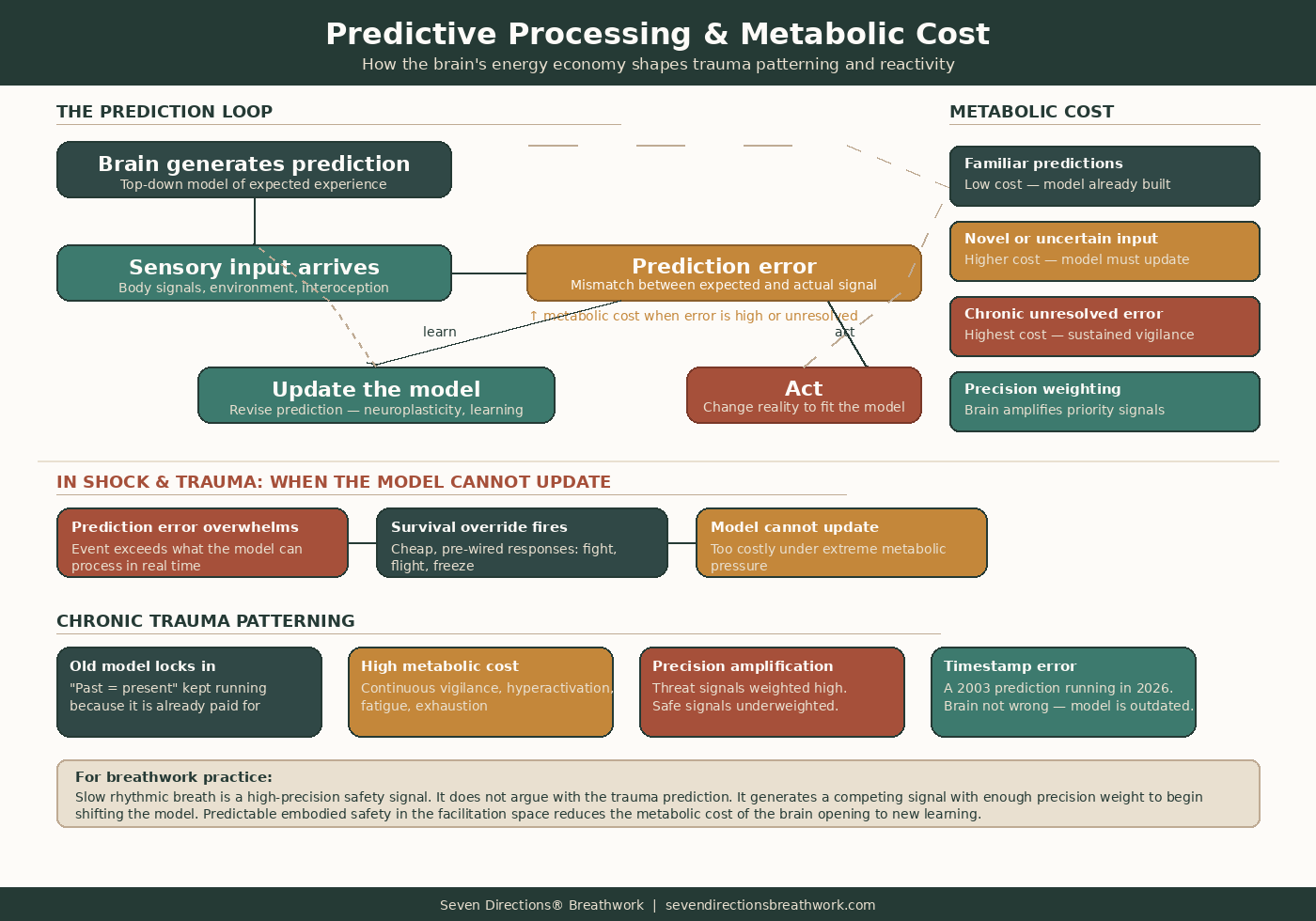
The traditional psychological sequence is backwards. Many of you may already know this but here’s the groundbreaking neuroscience of why a purely cognitive understanding fails and how somatic practices actually rewrite the nervous system.
**This article is written in two parts so the re-writing part will come next with some working tips for facilitators
The first thing to say here is that I’m not a neuroscientist, but I am qualified to speak as a human being with a wealth of experiences, many of which were rooted in trauma. I’m also a breathwork facilitator and teacher (the Founder of Seven Directions Breathwork) who sees many of these flash reactions on a regular basis in my client work and in our Breathwork Facilitator Training, not just with our clients but with students and team members too, including myself! Re-wiring can be a lifetime’s work.
Let’s start with a simple question: How many times have you sat across from a highly conscious, deeply self-aware client (could this be you?) who can articulate their childhood wounds with clinical precision, yet still finds themselves completely dysregulated by a minor email or a neutral look from a person they’re interacting with?
They/you/we have done the talk therapy and read all the books. They/we may have the intellectual vocabulary down to a science (boy do I recognise myself in this!) I always said that I could talk my way around most therapists because part of the highly attuned and hyper vigilant nervous system safety I created was building intense defences around those core vulnerabilities. My intellectual vocabulary was astonishingly good and it kept me ‘safe’ or at least I thought it did.
Despite having done all the therapy and read all the books, the moment a trigger hits, logic evaporates and we are instantly thrown back into a defensive, mobilised, or completely frozen state, often faster than a forest fire!
As facilitators and space holders, this is the ultimate frustration: Why can’t brilliant people think their way out of trauma? Why can’t we apply rationale to our responses?
The answer is simple, clean, and entirely neurological: Because the human brain is not a reactive organ, it is a predictive one.
The Death of the Reactive Model
For decades, traditional psychology operated on a linear, reactive model of human behavior. It looked something like this:
Stimulus —> Emotion —> Nervous System Response
Under this outdated paradigm, you see or perceive a threat (the stimulus), you feel fear (the emotion), and your heart begins to race (the nervous system response).
If this were true, cognitive-behavioral tools would work flawlessly. You would simply change your thoughts about the stimulus, shift your emotion, and calm your body down. Imagine that! I know that my own friends who have experienced anxiety or depression over the years, have found it incredibly frustrating over the years when they’ve been told that they just need to change their thoughts and they’ll get better.
The groundbreaking neuroscience of Dr. Lisa Feldman Barrett has completely upended this sequence. The truth is that your nervous system shifts well before you ever consciously interpret what is happening around you.
The actual biological pathway flows in reverse:
Bodily Preparation/Prediction —> Stimulus —> Experience —> Confirmation or Update
Your brain doesn’t wait for the world before it acts. It’s constantly running subconscious algorithms in the background to efficiently manage your internal resources and the overall reduce metabolic cost to your system. It is perpetually asking three questions:
What is this situation likely to be?
What will my body need in the next few seconds?
How much energy do I need to mobilise right now?
For part two of this article, please subscribe or follow us on Substack
For more great info you can visit our breathwork training website or better still, come and join us!
Visit my personal website
If you’re at the start of your breathwork journey, please visit our Breathwork Foundations on demand self study course.
References
Barrett, L. F. (2017). How emotions are made: The secret life of the brain.Houghton Mifflin Harcourt.
Barrett, L. F. (2017). The theory of constructed emotion: An active inference account of interoception and categorization. Social Cognitive and Affective Neuroscience, 12(1), 1–23. https://doi.org/10.1093/scan/nsw154
Clark, A. (2016). Surfing uncertainty: Prediction, action, and the embodied mind. Oxford University Press.
Dana, D. (2018). The polyvagal theory in therapy: Engaging the rhythm of regulation. W. W. Norton & Company.
Friston, K. (2010). The free-energy principle: A unified brain theory? Nature Reviews Neuroscience, 11(2), 127–138. https://doi.org/10.1038/nrn2787
Levine, P. A. (2010). In an unspoken voice: How the body releases trauma and restores goodness. North Atlantic Books.
Maté, G. (2003). When the body says no: The cost of hidden stress. Knopf Canada.
Porges, S. W. (2011). The polyvagal theory: Neurophysiological foundations of emotions, attachment, communication, and self-regulation.W. W. Norton & Company.
Porges, S. W. (2022). Polyvagal theory: A science of safety. Frontiers in Integrative Neuroscience, 16. https://doi.org/10.3389/fnint.2022.871227
Seth, A. K. (2021). Being you: A new science of consciousness. Dutton.
Seth, A. K., & Friston, K. J. (2016). Active interoceptive inference and the emotional brain. Philosophical Transactions of the Royal Society B, 371(1708). https://doi.org/10.1098/rstb.2016.0007
Sterling, P. (2012). Allostasis: A model of predictive regulation. Physiology & Behavior, 106(1), 5–15. https://doi.org/10.1016/j.physbeh.2011.06.004
van der Kolk, B. A. (2014). The body keeps the score: Brain, mind, and body in the healing of trauma. Viking.